top of page

Dialogues in Coproduction

Fairville’s Dialogues in Coproduction is a curated on-line public seminars programme dedicated to the co-production of just cities. Open to residents, activists, academics, professionals, alongside other actors from civil society organisations and local governments, the Dialogues in Coproduction aim to nurture co-learning, exchange  and networking amongst an international community of practice interested in exploring and learning from real-life experiments addressing the growing social, spatial, environmental and political inequalities in our cities.
The Dialogues bring together Fairville partners and a wider community of practice to examine how meaningful coproduction can be initiated, strengthened and embedded in European urban governance, and are designed to anchor the development of policy propositions for local and regional authorities. 

Launched in April 2025, the first phase of the programme has progressed from actor-focused discussions to sector-based in-person and on-line sessions on housing, the environment and urban risk. From January to April 2026, the programme will shift to a four-part
Enabler Series exploring the foundational conditions, resources, regulatory frameworks and safeguarding measures needed to advance and scale community-led co-production. 

The series will conclude in September 2026 with a collective workshop shaping evidence-based propositions for more robust, routine co-production across European cities.

Upcoming Dialogues in Co-Production Events

Co-producing the City from below - from Brazil to France // Coproduction par le bas - Approches franco-brésiliennes [Online]

11th June 2026, 15h-17h CET / 2-4pm BST

Various forms of co-production in urban planning have been in practice for at least half a century, supporting grassroots urban development in France and Brazil. These initiatives emerged historically in the 1970s through collaboration among various actors—committed urban professionals, students, mobilized residents, and housing rights activists—in very distinct neighborhoods in both countries: from working-class neighborhoods in northern France to self-built settlements on the outskirts of São Paulo. In contexts of metropolization and planned urban renewal—and even the financialization of housing—how has co-production enabled us to challenge residential inequalities and forms of citizenship, and to overcome obstacles to democracy over the past several decades? As part of this session, we will welcome several French and Brazilian members of the Franco-Brazilian research project ANR-Fapesp Copolis to mark the launch of two books published in France and Brazil, and a special issue of the journal Participations. This project and these publications will be presented in light of three central questions:  
 
  • Does co-production help maintain countervailing powers and take urban mobilizations seriously in order to shape the city and fight “for the city”?   
  • What is the role of academic and professional intermediaries in these co-productions,  balancing guidance and support for mobilized collectives in contexts of precariousness and repression?  
  • How do these practices challenge the ways in which demands and actions for a more just city are collectively developed and advanced?
EN Dialogues France-Brazil 11 juin.png
FR Dialogues France-Brazil 11 juin.png

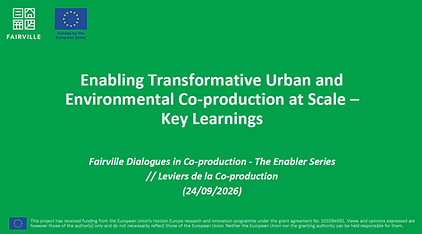
Enabling Meaningful Co-production at Scale – Key Learnings
[Online]

24th September 2026 (time TBC)

​

More information coming soon...

A Manifesto for Just and Democratic Housing in European Cities 
//
Manifeste pour un Habitat Juste et Démocratique en Europe

[In-presence, Paris | Event in French language only]

11th May 2026, 17h30 - 21h, ENSA Paris-La Villette

Le Manifeste pour un habitat juste et démocratique dans les villes européennes a été élaboré collectivement lors d’un événement qui s’est tenu à Roubaix, à l’occasion des journées mondiales de l’habitat début octobre 2025. Organisé par le consortium Fairville, avec le collectif roubaisien “Non à la démolition dans le quartier de l’Alma-Gare”, cet événement a réuni des militant·es pour le logement, des organisations intermédiaires, des chercheur·ses universitaires engagé·es et des professionnel·les progressistes de toute l’Europe pour un moment de réflexion et d’action sur la crise du logement en Europe. Ces échanges ont permis la rédaction du manifeste, coordonnée et consolidée par des chercheur·ses de la Bartlett Development Planning Unit (DPU), de l’University College London (UCL) et du Centre national de la recherche scientifique (LAVUE-CNRS). 
​
Alors que le logement est un sujet central de préoccupation en Europe et au-delà, et que la Commission européenne a présenté mi décembre 2025 un plan européen pour le logement abordable, ce manifeste résume les priorités et les aspirations issues des quartiers et des initiatives citoyennes en matière de logement. Le manifeste consiste en un ensemble de revendications servant de feuille de route pour penser un avenir plus juste, plus démocratique et plus durable en matière de logement, d’habitat et d’urbanisme dans les villes européennes. Il sert aussi de point de référence collectif autour duquel ancrer les efforts de vigilance.  Cette démarche est nécessaire dans un contexte où le plan européen initial a été “revisité” mi mars avec la publication du rapport final de la commission spéciale sur la crise du logement, qui porte une vision plus préoccupante des politiques du logement.
Manifeste 11 mai Paris a (3).png
Manifeste 11 mai Paris b.png
The Manifesto for Just and Democratic Housing in European Cities was produced collectively during an event held in Roubaix as part of World Habitat Days in early October 2025. Organized by the Fairville consortium, in collaboration with the Roubaix-based collective “No to Demolition in the Alma-Gare Neighborhood,” this event brought together housing activists, intermediary organizations, engaged academic researchers, and progressive professionals from across Europe for a moment of reflection and action on the housing crisis in Europe. These discussions led to the drafting of the manifesto, coordinated and consolidated by researchers from the Bartlett Development Planning Unit (DPU), University College London (UCL), and the National Center for Scientific Research (LAVUE-CNRS). 

With housing being a key concern in Europe and beyond, and following the European Commission’s proposal in mid-December 2025 of a European affordable housing plan, this manifesto outlines the key priorities and aspirations emerging from neighborhoods and citizen-led housing initiatives. The manifesto consists of a set of reflections and demands serving as a roadmap for envisioning a more just, democratic, and sustainable future in terms of housing, living environments, and urban planning in European cities. It also serves as a collective reference point around which to anchor efforts to stay alert. This approach is necessary in a context where the initial European plan was “revised” in mid-March with the publication of the final report of the special commission on the housing crisis, which presents a more concerning vision of housing policies.

Dialogues in Coproduction - Enabler Series

The Enablers Series focuses on the conditions that enable meaningful co-production to develop and to shape the production of practices, policies, plans, services and places that communities push for. Beyond co-learning and networking, the series aims to support the articulation of shared demands and propositions to help strengthen co-production practices at scale. 

The Enablers Programme

#1

Establishing/Grounding Meaningful Co-Production
15 January 2026
3-5pm CET / 2-4pm GMT

#2

Resourcing for Meaningful Co-production*
12 February 2026
3-5pm CET / 2-4pm GMT

#3

Regulating for Meaningful Urban
Co-production at Scale*
12 March 2026
3-5pm CET / 2-4pm GMT

#4

Defending Meaningful Co-production
16 April 2026
3-5pm CET / 2-4pm GMT

*These sessions will be run in collaboration with a sister Knowledge Exchange programme focused on Co-Produced Housing in the context of the recent EU Affordable Housing Plan.

  • Instagram
  • Facebook
  • Youtube
  • LinkedIn
European Union (EU) Flag vector logo.png

This project has received funding from the European Union’s Horizon Europe research and innovation programme under the grant agreement No. 101094991

​

The associated partners The Bartlett Development Planning Unit (DPU) of University College London (UCL), Just Space and Co Produce It CIC's work on this project is funded by the UK Research and Innovation (UKRI) under the UK government’s Horizon Europe funding guarantee.

Home page photos by Audrey Debargue

Sketches by Sylvain Adam

bottom of page