
Networking dynamics to amplify the voice and rights of local communities

As part of the Fairville peer-to-peer series, organised to encourage the exchange and interaction among project Labs, some members of the London Lab and of the Marseille Belle de Mai met to discuss the importance of local networks in their context and the various advocacy dynamics they drive. Both Labs focused on housing issues during the discussion, especially addressing tenants/residents rights and needs. The aim of the discussion was to understand how the respective local groups and networks are organised, which objectives they have, which groups of citizens they represent or seek to empower, which strategies they use to achieve these objectives and what is the role and added value of the network in this process.
Experiences from Marseille
A large-scale campaign against poor housing conditions
The case of Marseille focuses on the Belle de Mai district, one of the central neighbourhoods in the 3rd arrondissement/district of Marseille with a high percentage of housing stock below the housing standard. A collaboration between local actors has been already in place since several years in other districts, bringing together community initiatives and universities / research groups.
On the 5th November 2018 the tragic collapse of two residential buildings on Rue d'Aubagne, due to bad conditions, claimed the lives of eight people. After that, the City initiated a large number of building evacuations (almost 580 buildings, corresponding to more than 4 500 inhabitants) in the months following the collapse, in response to reports of serious and imminent danger. These tragic episodes highlighted the pressing nature of the housing issues and the urgency to support the needs of local residents, especially the most vulnerable ones, leading to a more structured collaboration among local actors.
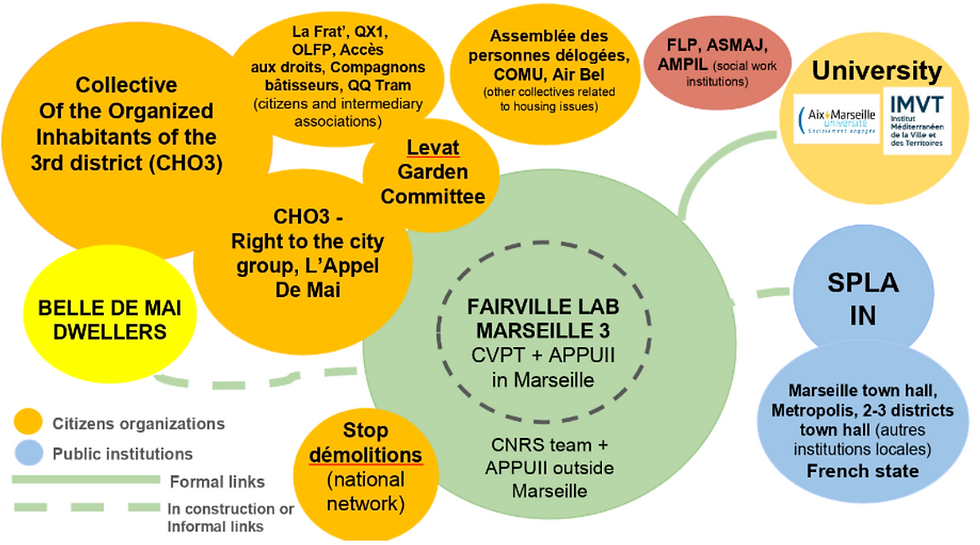
The Fairville Lab took advantage of this collaboration heritage to build its own network in the framework of the Lab (Figure 1). The lab emerged in the context of a major urban project to redevelop the city centre and renovate old buildings. This regeneration project, the Projet Partenarial d’Aménagement (PPA) piloted by the Aix-Marseille-Provence Metropolitan Area, the City of Marseille, the French government, and seven other partners was developed following and in response to the tragedy of “Rue d'Aubagne”.
A support(ive) network, involving those affected
The main objective of this network of local actors is to help the inhabitants to stay in their place of residence, if they wish too, despite urban transitions, fighting against evictions and for better housing conditions and standards. The idea of the network is to create a better structure, to help inhabitants navigate the complexity of the context, make them feel less isolated and support them in understanding who is responsible for what at the local level and where to seek for help. At the same time, the network seeks to help active groups and institutions to fight for similar problems and for the same rights, to share complementary skills and find alternatives together. The main target of the network’s requests are public authorities, the public developer, PPA and housing developers.
The tools and strategies used by the network in Marseille
The initial agency to develop a series of tools and strategies to achieve the network's objectives comes from the core Fairville Lab. Yet most activities rely on a large local and beyond- network (see Figure 1). Some examples include:
Workshops to foster co-learning and counter-expertise
Door-to-door survey: this survey was developed and performed to learn about the people's living conditions and have an overview of the district. The cooperation among different partners of the network, combining their different skills and drawing from previous experiences, was highly important to develop it and collect the data, which focused more on sociological and qualitative information (more details in the resources linked below). The survey helped to get higher credibility with the developers.
Community meetings: thanks to the network and its connections, the local groups are able to organise meetings, also involving groups from other contexts and cities, to share knowledge and empower the local groups and residents.

Next steps for the network in Marseille
The network is now focusing on advocacy actions towards public institutions. A first link was made with an organization experienced in advocacy, on the issue of the "rue d'Aubagne collapse", involving the first affected people. Other meetings were planned with the local institutions, during the end of 2025. Another priority for the network is to make links with other organizations focusing on the Right to housing and to increase communication around this topic. Finally a local group of inhabitants has been created and named “l’Appel de mai”. L’Appel de mai is the collective which will take over the Marseille lab activities after the end of the Fairville project.
Experiences from London
Grassroots organizations with a long history
In the case of London, the network experience concerns a wider scale, not only at the neighbourhood level. Local groups started to organise themselves at the city-wide scale more than 20 years ago to fight for tenants’ and residents’ rights within the planning system: the first organisation was the London Tenant Federation (LTF), bringing together tenants and residents associations from the 32 districts of London; Just Space (JS) came after, with a supporting and connecting role for the LTF.
These organizations collaborate in many ways and organize conferences and workshops together, they work on particular policies related to housing and cooperate with Universities and NGO’s such as ‘Friends of the Earth’ on research and monitoring activities. Other organizations with specific skills are also involved in the network, such as the Public Interest Law Centre (PILC) that has technical experience on legal issues and social housing, with a team specifically focusing on gentrification and demolition issues.
Tenants and residents fight against demolition and eviction
The main objective of the network is to give a direct voice to the tenants and residents on policy issues. In the context of housing, the network aims to support people living in social housing estates threatened by demolition and in general impacted by planning and development processes in the city. The idea is to bring skills from different organizations and institutions together, to offer clear and concise information about how the system works, its rules and conditions, to organize events and meetings at the local level to bring people together and allow discussions, and to provide technical support (such us legal advice and legal action).

The tools and strategies used by the network in London
The network uses a series of tools and strategies to achieve its objectives, such as:
“Estate Watch”: this project, started by London Tenants Federation and Just Space and funded by universities, aims at mapping the housing estates threatened by demolition in London, to monitor these sites and and provide support to the tenants and residents. University funding is in return for access to estate meetings and contacts for interviews. However, it should be emphasised that the Estate Watch meetings are tenant/resident-led and planned for them to have a dedicated and safe space to discuss issues and take decisions. A website provides updates on the mapping and monitoring process, as well as simple documents with clear information for tenants and residents impacted by the demolition threats.
Court cases and Community Law Centres: making use of the law is essential for threatened estates, because the planning system is against them and usually the local authority will give permission for the demolition and redevelopment. However, because of a lack of skills in the local authority departments, and a disregard of people’s rights, if tenants can access legal support and bring the case to court, they can sometimes stop the demolition process. This is possible thanks to the work of the Community Law Centres, such as the PILC mentioned above.
“SHAPE”: a cooperation between 3 different organisations: i) tenants federation, ii) planning network and iii) activists group (Defend Council Housing). All 3 are active on housing issues in a district of London, Southwark, to fight against the planned demolition of a big district portion. They organise regular demonstrations, bringing hundreds of people in the streets, using the stalls technique (table with banners and leaflets etc.) to attract ordinary people to the protests. A local "independent" newspaper is covering these demonstrations, highlighting the role of the media.
Learnings
The role and objectives of a local network
1
Expertise and skills Gather the knowledge, the expertise and the skills that a small group or individuals can’t provide.
2
Advocacy / “interpellation” / empowerment Exert the influence that individuals don’t have, strengthen the power of vulnerable groups, amplify residents voices.
(Common) challenges and strategies
Challenges:
Temporary nature of a network: members joining and leaving, different levels of commitment of members/groups involved, unstable relationships with public/private institutions that can be unstable over time.
Power dynamics: when partners involved have different levels of commitment and roles (also due to financial resources), issues might arise in the co-production process, in the collection and use of data etc. As mentioned in the discussion, this could be true for collaborations with universities, for example, if the work of organisations is used for research and results are not shared or decisions are not co-designed with tenants and residents. The risk might be carried as well when power dynamics and hierarchies in the group are not well balanced.
Democracy issues: involvement of all groups (e.g. socio-economic background, ethnic minorities etc.) and collaboration among political spectrum is often difficult in these networks, leading to a less just approach.
Temporary nature of housing options: tenants that don’t have secure housing are more difficult to engage in network initiatives and might have less access to housing rights and support.
Strategies:
Door-to-door activities: surveys, data collection, direct interaction with citizens that enables direct involvement of inhabitants and a stronger connection with the network.
Gathering spaces: meetings, conferences and workshops that provide a dedicated and safe space for tenants and residents to express their needs and make their voices heard.
Legal actions: court cases to enforce housing laws and protect tenants and residents rights.
Research actions: Mapping and monitoring eviction and demolition threats in different areas of the city, as well as surveys to assess housing conditions, to ensure clear information and tailored support for tenants and residents.
Public actions: demonstrations in the streets to raise awareness and highlight critical conditions.
Conclusions: the added value of a local network
From the experience of Marseille and London, we learned that local networks have a very important role and can bring added value to the community, especially to more vulnerable groups.
Such networks bring together different experiences and skills, increasing knowledge exchange and technical support for tenants / residents to meet their needs (e.g. legal, financial etc.). Doing this, they also simplify the context for inhabitants, especially more vulnerable categories: they make it easier to understand where to find information, who has the skills and resources to help with different issues, and which bodies to reach out to in case of need.
At the same time, local networks empower tenants / residents to take action with the support / protection of a bigger group, increasing the sense of belonging and reducing the isolation of individuals.
Finally, these networks are able to advocate for and with the communities, making sure the voice and the needs of vulnerable groups are heard and considered, for example through legal support, influence in decision making processes, and awareness actions through media and public demonstrations to advance a cause . They can also ensure a higher impact and result achievement rate with public institutions and other private actors, thanks to the strength of a critical mass and the trust and credibility among the inhabitants.
Useful resources/links:
The peer-to-peer session that inspired this article took place on the 17th of July 2025. The session was dedicated to project Labs only, and this article represents a summary of the discussion. To know more about this format and the work of the Labs, check out the report: "D3.5 Report of Co-production of Proposals" on the Outputs page.
Authors: Richard Lee (JustSpace), Alima El Bajnouni (APPUII)
Synthesis: Laura Guaita (ICLEI Europe), Sylvain Adam (CommonSpace)
Contribution: Agnès Deboulet & Kavyashree Swamygowda (CNRS)


Comments