
Fairville project: where are we? (Part 1)
Three years after the launch of the Fairville project, one of the Research and Innovation Action (RIA) under Cluster 2 – Democracy of Horizon Europe, Fairville has continued to experiment with co-production involving civil society actors, universities, and local authorities. The goal has been to foster multi-stakeholder engagement in addressing deep-rooted urban and environmental inequalities, together with affected residents and community groups. The broader ambition is to contribute to rethinking urban democracy and inequalities through the co-production of knowledge and action-oriented programmes.
Following this approach, multiple activities have been carried out across the eight pilot cases (Fairville Labs) – Brussels, Berlin, London, West Attica, Marseille (Belle de Mai and Atelier 4-5), Giza, and Dakar – to explore the potential of co-production in tackling inequalities and reducing democratic gaps. So far, the project has worked in multiple directions and across different scales, from building knowledge to understand the relations between inequalities, citizens’ engagement and democratic quality to nurturing key academic debates and starting building of a counter-manual of co-production for fairer cities. Still, Fairville has experimented co-production across different scales within the Fairville Labs, while also taking the time to co-evaluate their activities. Finally, it has focused on exploring pathways for embedding and/or scaling co-production processes, while also developing collaborative communicative and dissemination outputs to support this endeavour.
All the discussions that shaped these work directions were carried out in a spirit of openness and collaboration by the project partners and within the Fairville Labs. They were richly debated and thoughtfully developed together during Fairville meetings, such as the Open Citizens meeting in Brussels in November 2023 (link to blog post), the Fairville Mid-Term Meeting in Marseille in June 2024 (link to blog post), and the Intermediary Brussels Workshop in March 2025, as well as during public events, including the Fairville Mutual Learning Seminars (link to blog post) and the Dialogue in Co-production seminar series (link to blog post).
Three consecutive blog posts provide an update on the main advancements and ongoing key debates emerged in these fruitful years, as well as offers a summary of the project’s main achievements.
PART 1
Building knowledge to understand the relations between inequalities, citizens’ engagement and democratic quality
A key work of Fairville within WP1 has focused on building an initial knowledge base to explore how multiple forms of inequality – such as socio-economic, gender, disability, spatial, and ethnic – affect political participation, the quality of democracy, and its stability. In addition to gathering existing information on these inequalities (both over time and across different regions), this knowledge base also aimed to identify the root causes of these inequalities, how they intersect, and how they relate to democratic quality.
First, an extensive literature review on the relationship between inequalities, civic engagement, and democratic quality – carried out over more than a year – led to the creation of a structured and annotated repository of resources. These resources provide relevant data for Fairville’s themes at both global and local levels. The results are published in the “Report on Document Analysis” (link to report). The report is divided into two parts. Part One presents the sources collected on inequalities and political participation, the types of data they offer, key interpretations, and emerging trends on inequality and on quality of democracy. It also includes examples of grassroots initiatives that promote citizen involvement in areas such as social service management, urban regeneration, and climate crisis response. Part Two provides access to all the resources identified, making them searchable and usable for further analysis.
Second, Fairville launched a major campaign to collect “biographies of engagement” from citizens, activists, leaders of civil society organizations (CSOs), local authorities, volunteers, and association members within the Fairville Labs. In addition, a series of interviews were conducted with key informants – such as researchers, activists, and local leaders – who were involved in Labs’ activities. These in-depth biographical interviews explored personal experiences and knowledge of different forms of inequality, forms of civic engagement and co-production. A shared interview framework was used to accommodate the wide differences between countries. It addressed both variations in democratic deficits at local or city levels, public policy design, and governance, as well as differences in how inequalities shape engagement paths, perceptions, and their impact on individual and collective lives. The interviews also helped to explore how the Fairville Labs are tackling issues related to democracy and inequality.
The analysis of the collected data was done on the basis of a conceptual map (following a targeted literature review) showing the relationship between inequalities, engagement, and democratic quality. In particular, four main patterns emerged in the relationship between engagement and inequality:
Inequality can be a source and motivator for engagement.
Inequality can also be a barrier, discouraging engagement.
In some cases, inadequate engagement approaches fail to reduce inequality or may even reinforce or create new inequalities.
Under certain conditions (for example, hypothetically, when forms of co-production are implemented), engagement can effectively address inequalities, or at least help lay the foundation for doing so.
This 4-tier model is designed to organize existing knowledge rather than create new theories. Instead of looking at inequality and engagement separately, it focuses on their relationship and how these relationships affect the quality of democracy.
While fully aware of the complexity of the subject as a whole, the attempts were to summarise and visualise the relationship between inequality and engagement as effectively as possible, for the specific purposes of the project. Therefore, the team aimed to a) provide a concise overview of the mutual impacts between inequality and engagement, to identify the main aspects; b) develop a simple and usable tool to stimulate further theoretical exploration and provide a framework for self-analysis for the Labs and other similar experiences. Therefore, compared to a "traditional" conceptual map, this conceptual map is not "critical" and exhaustive, but rather a working tool. Indeed, for example, this tool allowed Fairville Labs to map specific phenomena relating to inequalities and engagement and also to compare different contexts, without underestimating the specificities of these contexts.
Furthermore, the conceptual map model used, allowed to identify aspects that might not have emerged with more focused and specialised approaches, such as the complexity of the mutually influencing relationships between inequality and engagement or the fact that some forms of engagement can become ineffective, if not an obstacle, in the fight against inequality. In doing so, a broad notion of engagement was used, compatible with the empirical variety of citizen engagement experiences, precisely to capture existing diversity.
The development of this conceptual map then allowed to formulate a hypothesis (to be verified in part in the Fairville project and above all in future research) regarding the presence of co-production traits (e.g. focus on empowerment, community-based data collection and monitoring systems, production of knowledge shared between different actors, etc.) and the greater likelihood of citizen engagement at the local level succeeding in the face of inequalities.
This conceptual map was “contextualised” by building a further “Map of the impact of inequalities on engagement and democratic quality across the Fairville network”, based on the information gathered from biographies and interviews in the Fairville Labs.
This further mapping activity allowed the team to a) validate the conceptual map; b) enrich the map with empirical elements; c) provide further insights for a structured reflection on the contributions and limitations of co-production.
Some outputs of this mapping activity are:
Ø In all contexts examined, some experiences emerge in which engagement has produced a positive impact in terms of reducing inequality on concrete aspects of urban living.
Ø What emerges is the capacity of citizens in producing real knowledge and not being just providers of “raw” information as in citizen science developments: countermaps, countreplanning, environmental reports, etc.
Ø Environmental inequalities tend to be perceived by all social strata, leading to the mobilisation, even (and especially) of relatively strong individuals with time and resources. This last aspect (together with other factors, such as the fragmentation of citizen groups and the poor ability to cooperate) can lead to limited and, in the long term, exclusionary forms of engagement.
Ø In cases of severe inequalities leading to engagement, there tends to be some intermediary body (NGOs, universities, international or governmental programmes) that offers support, capacity building, or even the opportunity to travel, confront other realities and get stimuli and suggestions to work in one’s local context.
Ø In cases where inequalities seem to discourage engagement, lack of time, lack of economic resources and also distrust of change and frustration tend to prevail as crucial factors. On the other hand, it seems that certain types of inequalities, such as those related to discrimination, may have greater impacts on the decision and willingness to engage.
Ø Although the gender dimension of the reported experiences needs to be further investigated, there certainly emerges a strong female subjectivity at various levels of engagement (from vision to information gathering to the promotion of collective action), even though some crucial aspects, such as the relationship with the authorities, are often still the prerogative of men.
Specific attention has been paid to the forms of co-production that emerged from the analysis of the biographies and other sources consulted. Particularly relevant are the forms of co-production of knowledge, which are based on a clear recognition of the knowledge mobilised by citizens.
As regards the different modes of engagement with which the different forms of inequalities appear to be addressed, based on the examination of the forms presented for the seven contexts considered, some brief considerations were made. The most recurrent modes of engagement are:
· The activities of claims, protest and conflict
· Knowledge co-production (by far the most cited by the biographical sources)
· The creation of support networks
· Actions to foster rights
· Collaboration with local authorities in some contexts and specific agendas.
The most recurrent intersections between modes of engagement and inequalities are highlighted here.
Ø To tackle economic and territorial inequalities (which are the most cited), the knowledge co-production; the request, protest and conflict; the creation of support network; the collaboration with local authorities; the self-managed initiatives are the most relevant.
Ø Also for addressing social inequalities, the knowledge co-production, the creation of support networks, the collaboration with local authorities, and the actions to foster rights prevail.
Ø To cope with environmental problems and pollution, the range of most common solutions is broader and includes knowledge co-production; the actions of risk management; the creation of support network; the creation of association; the collaboration with local authorities; the collaboration with universities and research centres; the request, protest and conflict.
Other forms of inequalities and modes of intervention recur, but less frequently.
In general, elements of co-production emerge strongly from the testimonies collected and are often intertwined with other, more traditional modes of collective action.
All these outputs are published in the report “Mapping of the impact of inequalities on political participation and democratic quality” (link to report).
Nurturing academic debates and the building of a counter-manual of co-production for fairer cities
A core component of Fairville has first focused on clarifying the theoretical debates around the project’s core concepts, that is co-production strategies to reduce inequalities and promote spatial and epistemic justice, and ways to broaden citizenship, participation, and democracy. Second, on producing a shared vocabulary (or glossary) for the entire team projects, along with an analytical framework to support comparative research.
This work, developed within WP2, began with a collective literature review on coproduction and urban contexts. It brought together researchers from different disciplines, backgrounds, and interests, allowing for rich exchanges. This process helped distinguish between community-led coproduction and institutional coproduction, laying the groundwork for the next phases of research (link to report).
Ongoing academic debates within Fairville are mostly grounded on a dialogue between different empirical stories of co-production for fairer cities emerging in the Fairville Labs, grounding on key questions:
· How are community-led and institutional coproduction connected? Are they part of a cycle? Does community-led co-production (Bénit, Deboulet, Faldi) aim to evolve into institutional co-production, where communities collaborate with public actors on urban issues?
· How do civil society groups involved in co-production balance the goal of influencing urban policy with the risk of being co-opted or losing their grassroots connection? What mix of antagonism and cooperation, pressure and trust, do they use in working with local institutions?
· Why is it often difficult for public institutions to engage in co-production with civil society? What are the main challenges, and what benefits do local institutions see in these processes?
In parallel, another essential part of the scientific work of Fairville focused on renewing and strengthening collaboration with civil society partners – especially around how they define and use key terms in their own local actions – to partly overcome the academic/civil society gap around the building of a glossary to support comparative analysis.
After several working sessions – rich in both productive and conflicting views on what a glossary should be – it became clear that civil society needed a stronger voice in shaping the language of the project. To help bridge the gap between academic and civil society perspectives, Fairville took time to deeply debate single concepts (for example the concept of “institutionalisation” during the Marseille Mid-Term Meeting), and mostly launched the Words in Action initiative, supporting civil society partners in developing their own stories, uses, experiences, and reflections on the key terms that mattered most to them. This process led to a shift in the planned output – from a simple glossary and analytical grid to what we now call a “Counter-manual for co-producion”.
What do we mean by a “counter-manual”? The term “manual” highlights that the practical dimension of this grounded output, both research oriented but eager to guide and inspire real-world action. Unlike traditional manuals, it consists in a collection of situated stories that pay close attention to local contexts. It doesn’t showcase “best practices” but it includes challenges, mistakes, and lessons learned, recognizing that we often learn more from failures than from overly polished success stories.
Developed through the experiences and work of the FAIRVILLE Labs and other co-production initiatives across Europe and Africa, the Counter-Manual brings together different perspectives on urban co-production and its practices. It is organised around 13 thematic entries, each bringing together four complementary perspectives:
· Words in Action — exploring how concepts related to co-production are understood and used in different contexts.
· What Academic Literature Has to Say — connecting these concepts and practices to academic debates in urban studies.
· Methods Cards — presenting practical tools and approaches for participatory and co-production processes.
· Lab Stories — sharing situated experiences from co-production initiatives, including their successes, challenges and failures.
The Counter-Manual is intended as a resource for researchers, activists, citizens, practitioners and other urban actors interested in understanding and practicing co-production. Rather than offering ready-made solutions, it invites us to explore how co-production is shaped by different contexts, actors and experiences — and what we can learn from them.
The Counter-Manual of Co-production is at available at this link: https://coprodmanual.hypotheses.org/
Experimenting co-production across different scales
One of the core pillars of Fairville’s work has revolved around the activities of the eight Fairville Labs – spaces where the co-production of knowledge has been activated as a strategy to tackle urban inequalities and enhance democratic practices at the local level. These Labs have empowered local communities, especially marginalized and often overlooked groups, by recognizing their lived experiences as valid and valuable forms of expertise.
Spread across very different geographical and socio-political contexts – from precarious neighbourhoods in Dakar to the outskirts of Cairo, from post-industrial areas in West Attica to working-class districts in Marseille, Brussels, Berlin, and London – Fairville has experimented with co-production at multiple scales. In each Lab, residents, civil society associations and researchers worked collaboratively: they ran surveys together (like in Marseille Belle de Mai), collected stories and testimonies (as in Brussels), and mapped their neighbourhoods (in Dakar, Giza, and West Attica). Inclusion was always at the heart of the process. Informal waste workers in Giza, Roma students in Aspropyrgos, women-led cooperatives in Diender /Greater Dakar), and market vendors in London were actively engaged as co-producers. Through sustained activities such as field visits, training sessions, and iterative workshops, the Fairville Labs have therefore started fostering community cohesion and strengthening connections between civil society, researchers, and public institutions.
By employing community-based research, participatory mapping, mutual learning, and targeted workshops, the Labs have promoted inclusion, built trust, and supported collective ownership of urban transformation processes. They have also provided tools to address knowledge asymmetries –particularly where information is inaccessible or deliberately withheld – enabling communities to generate and disseminate their own data to support local advocacy efforts. In this context, an ongoing commitment of Fairville, within WP3 in particular, has been to foster dialogue and the exchange of experiences both within and beyond the Fairville Labs, through:
Co-creating a toolbox to support the co-design of pilot actions (link to report).
Sharing of key experiences in the form of “Fairville Labs’ Stories” (https://storymaps.arcgis.com/stories/4be4290485e247808974951a31a87cb1)
Capacity building via a series of Mutual Learning Seminars on topics such as the co-production of socio-spatial justice, scaling co-production, collaborative mapping of inequalities, and ethics in co-production.
Peer-to-peer learning, including expert consultations on participatory video-making and collaborative mapping.
The launch of various collective mapping campaigns across the Fairville Labs. Comparing mapping methods across contexts is intended as a way to highlight challenges, insights, and achievements, enabling cross-lab learning and storytelling, and building shared knowledge on the potential of participatory mapping to address inequalities.
The storage and sharing of all documentation produced by single Labs or through inter-lab workshops in an open repository of learning materials (https://repository.participatorylab.org/en/organization/fairville), so that others can learn from and build on this work.
Being the experimentation of Fairville Labs rooted in everyday struggles related to housing, environmental degradation, and exposure to risk, Fairville reveals its core ambition to explore how co-production can lead to more inclusive urban governance and give local communities a stronger voice in shaping their future.

Briefs from the Fairville Labs
Theme: Environmental Inequalities
Giza Fairville Lab (Egypt)
Actors involved in the Lab: NSCE, with local CSOs (El Reyada, Dahshur Tourism Development) in addition of Cairo Waste collectors’ association
Enlarged Groups: Residents, informal waste pickers, women, youth, school communities, local CSOs
In Mansheyat Dahshur, the Giza Lab partnered with the community to tackle waste issues through co-creation. They supported informal waste pickers, reimagined a local dumpsite as a shared public space, and prioritized inclusion by involving women and youth. Activities ranged from mapping to workshops with youth parliament members, CSOs, and local officials. Despite poverty and weak institutions, the project showed how collaboration can lead to practical solutions and new partnerships.

Marseille 4–5 Fairville Lab (France)
Actors involved in the Lab: AMU-Department of Sociology, Ecole Nationale Supérieure du Paysage (ENSP), MESOPOLHIS (research institution AMU-CNRS-IEP), students, district and central municipalities of Marseille
Enlarged Groups: Municipal agents, local councillors, students, academics, civil society organisations, residents, school communities
This Marseille 4–5 Lab bridges local government and civil society to co-produce knowledge on spatial and environmental inequalities. It hosted exhibitions and feedback sessions on topics like river restoration and public bath access in underserved neighbourhoods, drawing 30–70 participants. The Lab also ran university seminars, supported student projects, and conducted interviews on urban education. While it maintains ties with central city officials, relations with the district municipality are strained due to political tensions. Despite this, the Lab fosters dialogue and enriches local debates on urban change.

West Attica Fairville Lab (Greece)
Actors involved in the Lab: COMMONSPACE, local socio-environmental movements, groups of inhabitants, schools
Enlarged Groups: Residents, environmental activists, educators, Roma schoolchildren, researchers, local authorities
In Athens’ industrial outskirts, the West Attica Lab is documenting environmental injustices through a Participatory Atlas – a mix of maps, stories, and media created with the community. Highlights include a landmark visit to the Fyli landfill, where 40 residents, students, and officials saw the environmental impact first hand. Workshops in Elefsina and the Thriassio Plain explored pollution, abandoned infrastructure, and redevelopment. A standout project, From Home to School, involved 19 Roma students in creative workshops to explore and reimagine their neighbourhood’s environment. The Lab also took part in public events, including a 50-person conference and a municipal planning session with 80 attendees. Through interviews, meetings, and long-table discussions, the Lab connects community knowledge with policy, giving voice to some of Athens’ most marginalised groups.
More information: https://www.fairville-eu.org/post/inside-the-landfill-a-community-visit-to-the-waste-management-facilities-of-west-attica

Theme: Planning and Housing Inequalities
Berlin Fairville Lab (Germany)
Actors involved in the Lab: University of Regensburg (RE), students from RE, TU Berlin and University of Biberach
Enlarged Groups: Local residents, Rathausblock activists, institutional stakeholders, students, researchers
In Berlin’s Kreuzberg district, the Lab follows the Modellprojekt Rathausblock, exploring how urban space is shaped through participation, alliances, and institutional negotiation. Using ethnographic and spatial research, the team regularly engages in the Rathausblock process through observing forums, workshops, and informal gatherings. The Lab mapped stakeholder networks and hosted a three-day co-production workshop with 30 students and local actors. The work revealed barriers to participation – especially for marginalised groups – and tensions between institutional goals and community needs. Despite these challenges, the Lab sheds light on inequalities and institutional apathy hindering inclusive governance.
More information: https://www.fairville-eu.org/post/urban-co-production-the-case-of-berlin

Marseille La Belle de Mai Fairville Lab (France)
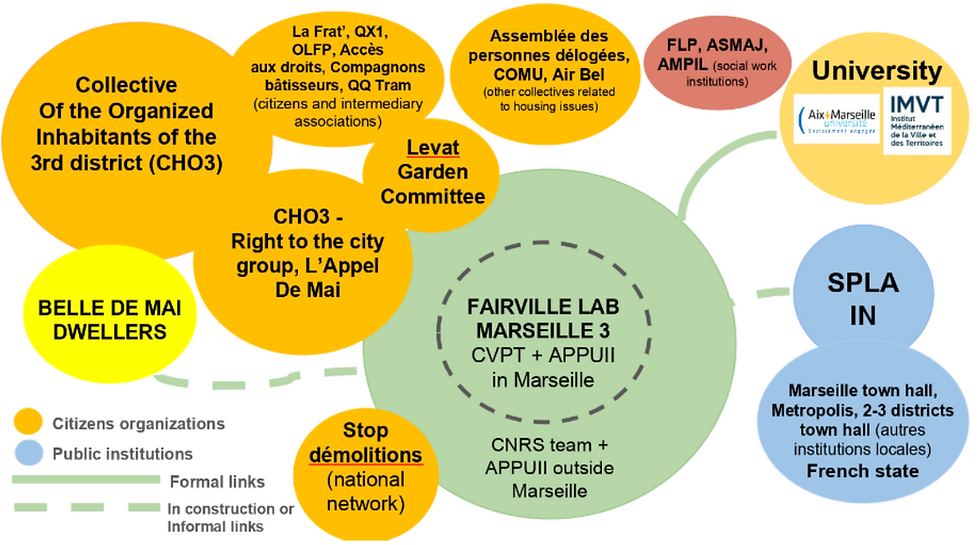
Actors involved in the Lab: initially CVPT, APPUII and CNRS; now it includes also residents' collective + CHO3 collective and for some activities the Institut Méditerranéen de la Ville et des Territoires (Aix Marseille University)
Enlarged Groups: Residents, housing activists, urban professionals, students, civil society organisations, local authorities, and public developer
The Marseille La Belle de Mai Lab works in a vulnerable urban renewal zone of the “Fringe of Euromed”, to explore whether current transformations reduce inequalities and to support local empowerment through co-produced knowledge and tools. A major achievement was a door-to-door housing survey, co-designed with residents, which reached 53 households and revealed issues like overcrowding and isolation. Results were shared at a public event and through multilingual leaflets during a local festival. The Lab also ran workshops, urban walks, and mapping sessions with residents and university partners. Lab’s activities, beyond data collection, helped residents access housing information, join urban debates, and connect with others, thus strengthening community participation, laying the ground for future advocacy efforts and ensuring local voices continue to play a key role in shaping urban policies. The lab has now a continuous involvement in advocacy and “right to question” campaign on deteriorated housing and urban democracy.

Theme: Risk Inequalities
Brussels Fairville Lab (Belgium)
Actors involved in the Lab: EGEB, ULB, Ixelles municipality, network Delier les fils de l’eau, group of inhabitants
Enlarged Groups: Residents of Gray Street and surrounding areas, grassroots organisations, municipal stakeholders, researchers
The Brussels Lab tackles chronic flooding in the Gray Street valley, where risk exposure meets social vulnerability and fragmented governance. The Lab combines community-based co-production, driven by residents and civil society, with a more limited institutional co-production involving the municipality. In 2024, over 20 residents shared their experiences through a co-produced survey that documented the impacts of several flood events. This sparked the creation of residents working groups on flood co-diagnostic, civic advocacy, space and health. However, political instability have made the enlargement of the collaboration with local authorities challenging. The Lab acts as a living experiment in asymmetric co-production, community-based and institutional, revealing both barriers and opportunities for participatory governance.

Dakar Fairville Lab (Senegal)
Actors involved in the Lab: UrbaSEN, Senegalese Federation of Inhabitants (FSH) + recent partners, University Cheikh Anta Diop (UCAD), University Amadou Matar Mbow, local authorities, community organisations
Enlarged Groups: Residents of informal settlements, women’s housing cooperatives, local authorities, grassroots organisations, university researchers, and students
The Dakar Lab is helping communities in disadvantaged flood-prone areas co-design solutions for safer and more inclusive urban development. It specific focus was on Bayakh (Diender), where a new eco-affordable housing project – Cité FSH – is being developed with strong input from women’s cooperatives. Activities included drone mapping, interviews, and workshops with residents and municipal actors, in collaboration with university students. Parallel work in Wakhinane and Ndiarème addressed post-flood housing rehabilitation. Key events included a participatory workshop and an Advocacy Day with 150 attendees. The Lab continues to build partnerships with municipalities and develop action plans, blending grassroots energy with technical expertise to influence urban policy in Senegal’s fast-growing outskirts.

London Fairville Lab (UK)
Actors involved in the Lab: Just Space, Co Produce It CIC, UCL-DPU, Clapton Commons, Equal Care Co-operative (until 2023-2024), Spitalfields Housing Association, Save Brick Lane campaign, Friends of Queens Market, Future of London
Enlarged Groups: Street market traders, formal and informal carers and care recipients, community food and care activists and volunteers, grassroots planning networks and community groups, Local Boroughs, the Greater London Authority, planners and researchers.
The London Lab promotes community-led planning and co-production to address urban inequalities. In 2024–2025, the Lab launched Co-Produce IT CIC, a community interest company that delivers and develops 'impactful co-production projects that transform communities and foster social inclusion’.
The Lab focuses on three main areas: urban food systems and street markets, care systems, and the built environment, with key projects in Queens' Market in Newham, Brick Lane and Whitechapel markets in Tower Hamlets, and Clapton neighbourhood in Hackney. Activities include surveys, political petitioning, food hub development, and submitting representations to the London Plan Review process by advocating for more inclusive urban policies. Lab engagement activities span workshops, advocacy, community meetings and assemblies, as well as learning events.

The following Fairville members contributed to the writing of this blog post: Giuseppe Faldi, Kavyashree Swamygowda, Agnès Deboulet, Philippe Urvoy, Alfonso Alfonsi, Maresa Berliri, Daniele Mezzana, Claire Bénit Gbaffou, Mathilde Jourdam-Boutin, Eleni Mougiakou, Giorgos Velegrakis, Sylvain Adam, Catalina Dobre and Luisa Moretto.

Comments